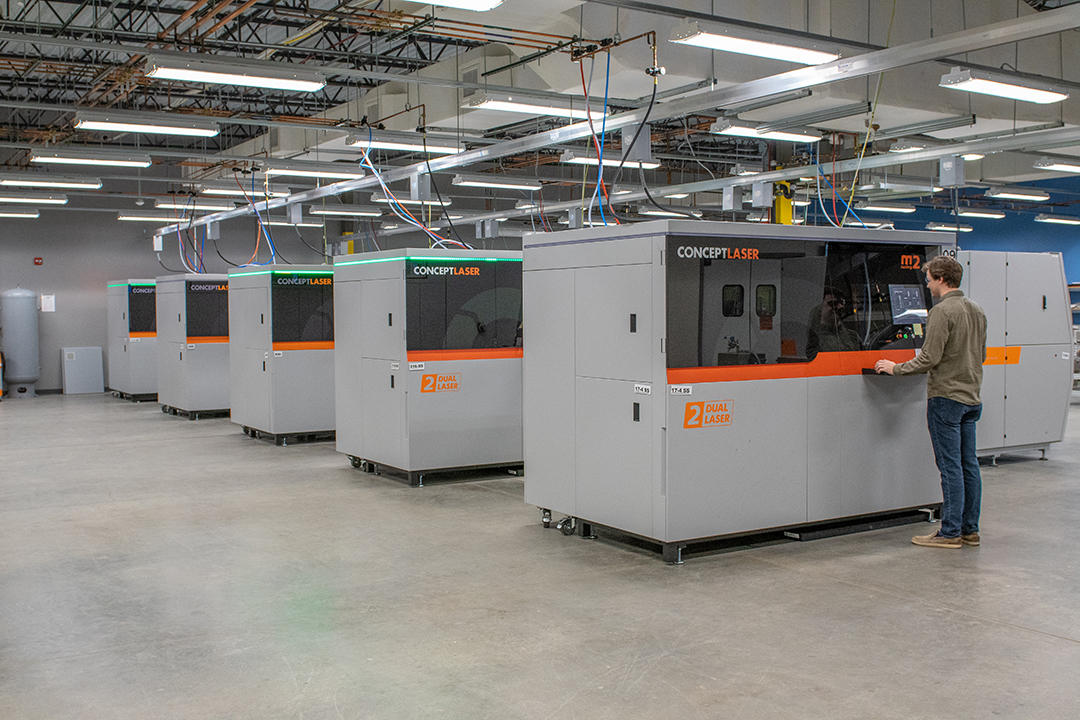
The Global Trade Group for Additive Manufacturing (AM), the Additive Manufacturing Green Trade Association (AMGTA), has announced that 12 major AM companies from eight different countries have now joined the effort to advance sustainability within the industry.
Established in 2019, AMGTA is a Florida-based consortium that aims to promote AM’s green credibility. To further its green business mission, the organization has announced that 12 leading AM companies from various sectors will join its membership list. The companies were eligible according to AMGTA’s sustainability criteria, and elected to promote the environmental benefits of AM in favor of traditional manufacturing methods.
“I am pleased to welcome each of these respected founding members and participating member companies to AMGTA,” said AMGTA Executive Director Sherry Handel. “Not only their commitment to support the mission of our new business group, but their passion for sustainability, puts AMGTA well placed to serve as a key industry resource in advancing sustainability in the AM industry . ”
History of AMGTA
AMGTA was launched in FormNext 2019, and co-founded by Sintavia, an additive manufacturer focused on the aerospace, defense and space industries. Joining the team were also Tato Nippon Sanso Corporation, a Japanese supplier of industrial gases and QC Laboratories, a subsidiary of Sintavia specialized in non-destructive laboratory testing.
The association aims to raise awareness in the public and manufacturing industries about the benefits of using AM not only in terms of cost and speed, but also in relation to sustainability. Once a company is listed as a participating member, AMGTA supports that company with marketing campaigns, sponsorship for their research, and publication of results. By doing so, it inspires participating companies to grow in a sustainable direction.
Referring to sustainability in additive manufacturing at FormNext 2019, Sintavia CEO Brian Neff stated that “benefits include improved end-use design usability and improved industrial ecology of the manufacturing process. AMGTA aims to deliver these benefits within the end market segment. Awareness has to be increased so that the rate of adoption of technology can be accelerated.
In June 2020, AMGTA announced a systematic review to investigate the environmental impact of metal 3D printing. The project was led by Dr. Faludi, an assistant professor of design engineering at Delft University. The project includes a research paper examining the impact of metal 3D printing on the environment, and is intended to be shared with industries and stakeholders.
12 new members and criteria
The companies joining AMGTA are from a wide spectrum of industries including engineering, software and manufacturing. New members include AMEXCI AB, a Swedish accelerator for the adoption of 3D printing technologies, with Danish AM Hub, Denmark’s focal point for the additive manufacturing ecosystem. He is accompanied by global supplier EOS, a leading PBF machine manufacturer, GE Additive, a 3D printer OEM consulting service, and a leading additive manufacturing software developer.
The rest of the members include the National Manufacturing Institute of Scotland which is involved in industry-led manufacturing facilities. A driver of design and industrial manufacturing, Siemens Digital Industries Software is contributing with its Accelerator Digital Enterprise portfolio, while also becoming a member of SLM Solutions and Stryker, formerly a German leading provider of metal 3D printing machines and the latter Vala is a US-based medical technology. company.
In terms of eligibility criteria, companies must meet four standards. Firstly, a major part of the companies’ revenue should be generated through AM during the previous financial year. Then, the company should have internal policies integrating waste reduction and sustainability.
Ideally, the company should be a member of the Green Business Bureau or other similar agencies. Finally, the company should be willing to publicly and actively promote the environmental benefits of 3D printing in end markets.
Stabilization and 3D Printing
Recently, there has been an increased awareness of the potential environmental benefits of 3D printing technologies. In areas such as construction and 3D printing materials, new sustainable innovations are on the market.
In terms of content, Dutch 3D printing filament vendor, Reflow, has launched ‘Seaglass’ a new environmentally friendly translucent material. The latter is made of locally sourced plastic and its structure mimics wildlife, overall it aims to limit plastic pollution worldwide.
Elsewhere, researchers at Vilnus University in Lithuania and Kaunas University of Technology have created an environmentally friendly recyclable resin made from soybeans.